
What Makes a Good AI Beauty Assistant?
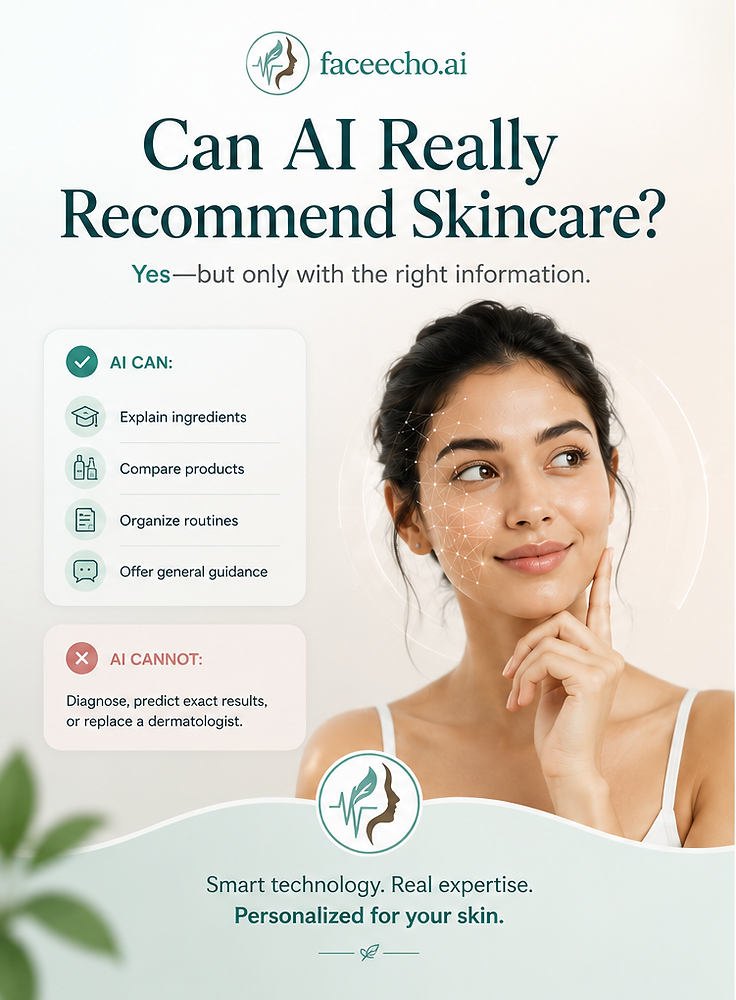
ChatGPT, Claude, and Gemini can help explain ingredients, compare products, and organize a routine — but useful skincare guidance requires more than an uploaded photo.
QUICK ANSWER
AI can recommend skincare in a limited but useful way. Tools such as ChatGPT, Claude, and Gemini can analyze the information and images a user shares, explain ingredients, compare products, and suggest how a routine might be organized.1,2,3 However, they cannot confirm a medical diagnosis, accurately predict how every product will perform on an individual, or replace a dermatologist. A good AI beauty assistant gathers relevant details, distinguishes education from medical advice, explains the reasoning behind its suggestions, acknowledges uncertainty, and involves qualified human expertise when needed.
The Skincare Question AI Cannot Answer From a Selfie Alone
Ask an AI assistant to build a skincare routine, and it may produce a confident answer within seconds. It might recommend a gentle cleanser, vitamin C, a moisturizer, sunscreen, and a retinoid at night. The routine may sound reasonable, but that does not mean it is right for the person asking.
The central problem is not that AI lacks skincare information. Modern language models can process large amounts of written material, interpret images, and explain complicated topics in accessible language.1,2,3 The problem is that skincare decisions depend on details that may not be visible in a photograph and may never appear in a vague question.
Redness, for example, could reflect temporary irritation, sensitivity, acne, rosacea, an allergic reaction, sun exposure, or another cause. A shiny forehead could indicate oil, sweat, lighting, a skincare product, or makeup. Texture can look dramatically different depending on camera sharpening, shadows, distance, and image compression. Even in clinical dermatology, photographs must be interpreted alongside symptoms, medical history, lesion behavior, and sometimes in-person examination or testing.4,5
AI can observe. It can compare. It can organize possibilities. It should not pretend that an observation is the same as a diagnosis.
What Can ChatGPT, Claude, and Gemini Actually Do for Skincare?
ChatGPT, Claude, and Gemini are general-purpose AI assistants rather than dedicated dermatology systems. Their exact features change over time, but all three currently support forms of image input or file analysis through their consumer products or model platforms.1,2,3 That allows a user to upload a product label, ingredient list, routine, or facial photograph and ask questions about it.
For beauty consumers, their most reliable uses are generally educational and organizational.
They can explain what ingredients such as salicylic acid, niacinamide, ceramides, benzoyl peroxide, or retinoids are commonly used for. They can compare two moisturizers, identify potential duplication within a routine, suggest a simpler order of application, and help a user prepare better questions for a dermatologist. They can also account for stated preferences such as budget, fragrance avoidance, product availability, routine length, or interest in drugstore rather than luxury products.
Their answers are less dependable when the task moves from interpreting information to making a clinical judgment. Reviews of large language models in dermatology have found genuine potential for patient education and decision support, but they also identify risks involving inaccurate responses, inconsistent performance, weak source transparency, and overconfident language.4,5 A polished answer can still be incomplete or wrong.
ChatGPT, Claude, and Gemini: A Practical Comparison
| AI ASSISTANT | WHAT IT CAN HELP WITH | WHAT USERS SHOULD NOT ASSUME |
| ChatGPT | Reviewing images and ingredient lists, explaining skincare concepts, comparing options, and organizing routines | That an image-based observation is a diagnosis or that a suggested product is guaranteed to suit the user |
| Claude | Analyzing text and images, reviewing long product information, comparing routines, and explaining trade-offs | That detailed reasoning automatically makes the conclusion medically accurate |
| Gemini | Analyzing uploaded photos and files, answering product questions, and connecting visual and written information | That recognizing a visible feature reveals its cause or confirms a skin condition |
The best choice is therefore not necessarily the AI that sounds most certain. It is the one that asks useful follow-up questions, explains its assumptions, cites trustworthy information when possible, and clearly states when the available evidence is insufficient.
Why a Facial Image Is Useful, but Not Sufficient
A facial image can provide meaningful visual information. It may show the apparent distribution of redness, visible flaking, shine, uneven tone, blemishes, or changes across different areas of the face. Multiple clear images taken without filters and under consistent lighting may provide more visual context than a single photograph.
Still, an image cannot reveal everything an AI beauty assistant needs to know. It does not reliably show whether the skin feels tight after cleansing, whether a product causes burning, how long a concern has been present, whether it changes around the menstrual cycle, or whether the user is taking medication that affects the skin. It also cannot fully account for pregnancy, allergies, eczema history, prescription treatments, climate, sun exposure, or previous reactions unless the user provides that information.
There is also a fairness problem. In a widely cited study using a diverse dermatology-image dataset, leading dermatology AI models performed less reliably on darker skin tones and uncommon conditions.6 That research evaluated specialized dermatology systems rather than ordinary consumer chatbots, but the finding remains an important warning: performance measured on one group of images should not be assumed to transfer equally to every person.
This does not mean images are useless. It means images should be treated as one source of information rather than the entire foundation of a recommendation.
What Information Does an AI Beauty Assistant Need?
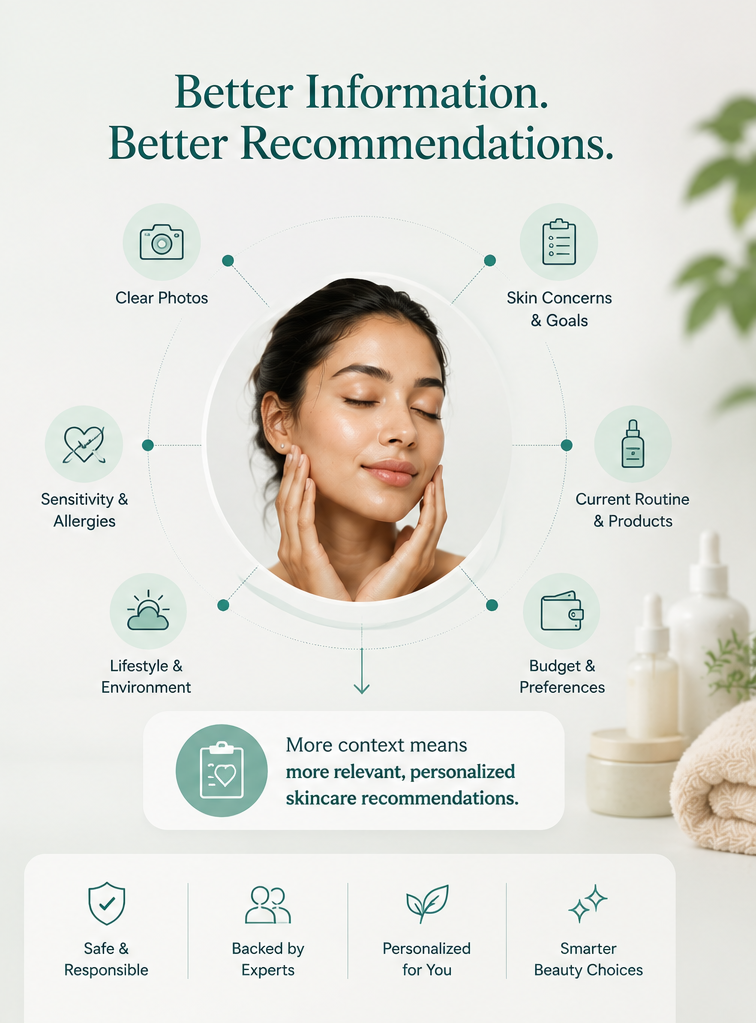
A useful skincare recommendation begins with a structured profile, not a guess. At minimum, an AI beauty assistant should ask about:
- The user’s primary goals and current concerns
- How the skin feels throughout the day
- Current products and prescription treatments
- Known allergies, sensitivities, and previous reactions
- Pregnancy or breastfeeding when ingredient safety may be relevant
- Budget, preferred retailers, and product availability
- Climate, sun exposure, and lifestyle
- The amount of time and number of steps the user can realistically maintain
These details change the recommendation. Someone using prescription tretinoin may need a very different routine from someone who has never used a retinoid. A user with fragrance sensitivity should not receive the same product list as someone who chooses products mainly by texture. A person asking for an affordable three-step routine should not be given ten expensive products simply because they are popular.
Dermatologists similarly advise consumers to choose products based on their skin’s needs, keep routines manageable, and recognize that using too many products can increase irritation.7,8 The American Academy of Dermatology also recommends testing a new skincare product on a small area before regular use, particularly when sensitivity or a previous reaction is a concern.9
New beauty platforms, including FaceEcho, are beginning to use this broader approach by combining visual information with user answers, preferences, product goals, and beauty-expert input. The important development is not simply that AI can look at a face. It is that a better system can ask enough relevant questions to avoid treating every face the same.
Why AI Alone Isn’t Enough
Artificial intelligence can process information remarkably quickly, but good skincare recommendations require more than speed. They require judgment.
That distinction matters because skincare is rarely about identifying a single “correct” answer. Two people with similar-looking skin may need completely different routines based on their medical history, current treatments, budget, lifestyle, personal preferences, and long-term goals. AI can organize this information and recognize patterns, but it does not have personal experience, clinical judgment, or the ability to physically examine someone’s skin.
This is where human expertise continues to add significant value.
Beauty professionals understand how products perform outside of controlled testing. They recognize that ingredient compatibility is only one part of the equation. Texture, finish, fragrance, ease of use, climate, makeup compatibility, and user habits all influence whether someone will actually follow a routine consistently.
Dermatologists contribute another level of expertise by diagnosing and treating medical skin conditions that AI should never attempt to confirm independently. Even advanced AI systems may produce incomplete, inaccurate, or overly confident answers in healthcare settings, which is why both researchers and the World Health Organization emphasize that AI should support, not replace, qualified professionals.
The strongest AI beauty experiences therefore combine three elements:
- Scientific evidence.
- Artificial intelligence for organization and personalization.
- Human expertise for judgment and oversight.
Rather than competing with one another, these strengths complement each other.
What Makes a Good AI Beauty Assistant?
Not every AI beauty tool is equally useful. Some simply generate generic routines based on common skincare advice, while others collect meaningful information before making recommendations.
A high-quality AI beauty assistant should:
- Ask relevant follow-up questions instead of making assumptions.
- Explain why a recommendation is being made.
- Distinguish established evidence from general opinion.
- Adapt recommendations to the user’s budget, experience level, and goals.
- Acknowledge uncertainty when the available information is limited.
- Encourage professional care when symptoms suggest a possible medical condition.
- Improve recommendations over time as more information becomes available.
Transparency is equally important. Users should understand whether recommendations are based on published evidence, ingredient comparisons, user preferences, or visual observations. An explanation builds more trust than a list of products without context.
The Future of AI-Powered Beauty
The next generation of AI beauty assistants will likely become more personalized rather than simply more intelligent.
Instead of generating a brand-new routine every time someone asks a question, future systems may remember long-term goals, previous product reactions, seasonal skin changes, and progress over weeks or months. This creates continuity rather than isolated recommendations.
Progress tracking may become one of AI’s most valuable contributions to beauty. Most people see their skin every day, making gradual improvements difficult to notice. Consistent photographs, routine history, and personal notes can provide a clearer picture of long-term change than memory alone.
Future systems may also become better at integrating multiple types of information. Rather than relying on text or images alone, they can combine:
- Images taken under consistent lighting.
- User-reported symptoms.
- Current skincare routines.
- Ingredient preferences.
- Budget considerations.
- Lifestyle factors.
- Long-term progress.
This broader context creates recommendations that are more individualized without suggesting that AI can perfectly understand every person’s skin.
At the same time, responsible development remains essential. The World Health Organization has emphasized that large multimodal AI systems used in healthcare should prioritize transparency, human oversight, fairness, privacy, and safety because inaccurate or biased outputs can influence health decisions.
The future of AI beauty is therefore not about replacing professionals. It is about giving consumers better tools to understand their options and make more informed decisions.
New beauty platforms, including FaceEcho, reflect this direction by combining AI-generated insights with structured questionnaires, progress tracking, and routines developed or reviewed by beauty experts. Instead of treating AI as the final authority, this hybrid approach recognizes that technology and human expertise each contribute different strengths.
What This Means for Your Beauty Routine
If you decide to use AI for skincare advice, treat it the same way you would treat an exceptionally knowledgeable research assistant.
Use it to understand ingredients.
Use it to compare products.
Use it to simplify complicated routines.
Use it to prepare better questions before seeing a dermatologist or beauty professional.
But avoid expecting AI to diagnose a skin condition or guarantee that a particular product will work for you.
The better your questions, the better the answers tend to be.
For example, instead of asking:
“Recommend a skincare routine.”
Ask:
“I’m 29, have combination skin with occasional hormonal acne, recently started using adapalene, prefer fragrance-free drugstore products, live in a dry climate, and want a simple three-step routine. Can you suggest one and explain why each product fits my concerns?”
Providing meaningful context allows AI to generate recommendations that are far more relevant and useful.
The future of beauty isn’t AI replacing human expertise.
It’s AI helping people make smarter beauty decisions with better information.
Frequently Asked Questions
1. Can ChatGPT recommend skincare?
Yes. ChatGPT can explain ingredients, compare products, organize routines, and answer skincare questions using the information you provide. However, it cannot diagnose skin diseases or guarantee that a recommendation is right for you.[1]
2. Can Claude analyze skin?
Claude can interpret uploaded images and discuss visible skin characteristics, but it cannot confirm medical diagnoses or replace an in-person examination.[2]
3. Can Gemini analyze skincare photos?
Yes. Gemini supports image analysis and can discuss visible features in uploaded images. Like other AI assistants, its observations should be considered educational rather than diagnostic.[3]
4. Can AI determine my skin type?
AI can make educated suggestions based on the information you provide, but skin type cannot always be determined accurately from a conversation or a single photograph.
5. Why do different AI assistants give different skincare advice?
Each model has different training methods, reasoning approaches, and safety policies. Small differences in prompts can also produce different recommendations.
6. Is AI better than a dermatologist?
No. AI is useful for education and organization, while dermatologists diagnose and treat medical skin conditions using clinical expertise.
7. Can AI recommend makeup as well as skincare?
Yes. AI can suggest makeup styles, shades, techniques, and products when given enough context about skin tone, preferences, occasion, and desired look.
8. Is personalized skincare really better than following social media trends?
Generally, yes. Dermatologists recommend selecting products based on your own skin’s needs rather than copying someone else’s routine because skin characteristics and tolerances differ between individuals.[7]
9. What should I tell AI before asking for skincare advice?
Include your age, skin concerns, current routine, allergies or sensitivities, prescription products, budget, climate, and skincare goals. The more relevant context you provide, the more useful the recommendations are likely to be.
10. Will AI replace beauty experts?
Probably not. The most effective systems are likely to combine AI with professional expertise rather than treating either one as a complete replacement.
References
[1] OpenAI. Images and Vision: Analyze Images with OpenAI Models. OpenAI Developer Documentation. Current documentation. Official source.
[2] Anthropic. Vision: Processing Images with Claude. Claude Platform Documentation. Current documentation. Official source.
[3] Google. Upload and Analyze Files in Gemini Apps. Google Gemini Help. Official source.
[4] Goktas P, et al. Assessing the Impact of ChatGPT in Dermatology. Clinical, Cosmetic and Investigational Dermatology. 2024. PMID: 39407969.
[5] Gui H, et al. The Promises and Perils of Foundation Models in Dermatology. Journal of Investigative Dermatology. 2024. PMID: 38441507.
[6] Daneshjou R, Vodrahalli K, Novoa RA, et al. Disparities in Dermatology AI Performance on a Diverse, Curated Clinical Image Set. Science Advances. 2022;8(31):eabq6147. DOI: 10.1126/sciadv.abq6147. PMID: 35960806.
[7] American Academy of Dermatology Association. 10 Skin Care Secrets for Healthier-Looking Skin. Updated October 29, 2024. Official guidance.
[8] American Academy of Dermatology Association. Skin Care on a Budget. Official guidance.
[9] American Academy of Dermatology Association. How to Test Skin Care Products. Updated August 10, 2021. Official guidance.