
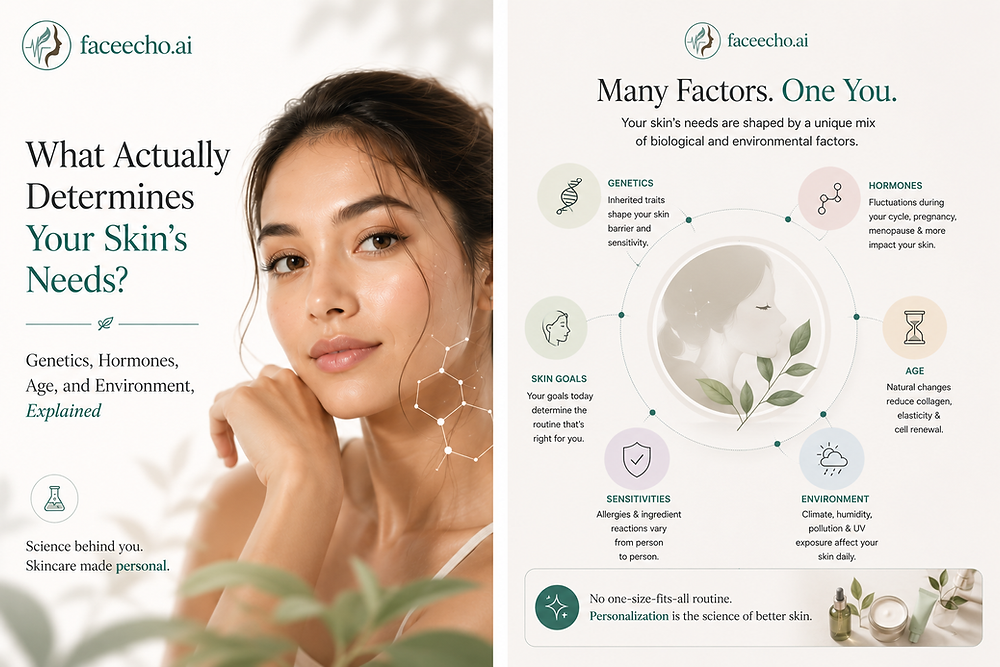
The Measurable Biological and Environmental Factors Behind Why Skincare Isn’t One-Size-Fits-All
Quick Answer: Skin needs are shaped by a combination of internal and external variables that differ for every person: inherited genetic traits that affect the skin barrier, hormonal fluctuations tied to puberty, the menstrual cycle, pregnancy, and menopause, the natural aging process, and external conditions like climate, pollution, and allergen exposure.[1][2][3][4][5] Because these factors interact differently in every individual, and often change over time within the same person, no single routine can account for all of them. Effective skincare has to be built around a person’s specific biology and environment rather than a universal formula.
Ask ten dermatologists what makes skin “healthy” and you’ll get ten similar answers about barrier function, hydration, and protection from damage. Ask what routine gets a person there, and the answers diverge immediately, because the starting point is never the same. Two people can have nearly identical concerns, dryness, breakouts, dullness, and need completely different approaches to solve them, simply because the underlying biology producing those concerns is different. Understanding what actually drives those differences makes it much easier to build a routine that works instead of one that merely sounds reasonable.
Genetics Set the Baseline for How Your Skin Barrier Behaves
A significant amount of how skin responds to products, weather, and irritants traces back to inherited genetic variation, particularly in the genes responsible for the skin barrier. The most studied example is the filaggrin gene (FLG), which encodes a protein essential for maintaining the structural integrity of the outermost layer of skin.[1] Loss-of-function mutations in this gene are strongly associated with a compromised skin barrier, increased water loss, and a higher likelihood of developing eczema and related sensitivities, and these mutations are present in a meaningful portion of the general population.
This matters well beyond people with diagnosed eczema. Even without a formal diagnosis, genetic variation in barrier-related genes means some people naturally retain moisture less efficiently, react more readily to potential irritants, and need gentler, barrier-supportive formulations as a baseline rather than an occasional adjustment. Someone with strong genetic barrier function might tolerate active ingredients like retinoids or exfoliating acids with little issue, while someone with a genetically more permeable barrier may need to introduce the same ingredients far more gradually, if at all. This single variable alone explains why identical products can produce completely different results on different people.
Hormones Change Skin Needs Throughout Life, Not Just During Puberty
Hormonal fluctuations are often associated with teenage acne, but their influence on skin extends across a person’s entire life. A scoping review of physiological changes during the menstrual cycle documents measurable shifts in oil production, hydration, and skin sensitivity tied to the rise and fall of estrogen, progesterone, and other reproductive hormones across the follicular, ovulatory, and luteal phases.[2] These shifts mean that a routine well-suited to the first half of someone’s cycle may not serve their skin equally well in the second half.
The same hormonal influence extends into pregnancy, postpartum recovery, and menopause. The American Academy of Dermatology notes that a growing number of adult women experience acne well past their teenage years, often tied to hormonal fluctuations from pregnancy, contraception changes, or the declining estrogen levels associated with menopause.[6] A routine designed around one hormonal life stage often needs meaningful revision at the next one, not because the person did anything wrong, but because their underlying hormonal environment has genuinely shifted.
Age Changes the Skin’s Structure, Not Just Its Appearance
Skin aging is frequently discussed in terms of visible signs, fine lines, sagging, uneven tone, but the underlying process is structural. Research on the mechanisms of skin aging distinguishes between intrinsic aging, a genetically programmed process involving cellular senescence and oxidative stress, and extrinsic aging, which results from environmental exposure, particularly ultraviolet radiation and pollution.[3] These two processes overlap but aren’t identical, which is why someone’s skin can age differently depending on how much of their lifetime sun exposure they’ve had, independent of their chronological age.
This distinction has direct practical implications. Skincare aimed at supporting intrinsic aging tends to focus on ingredients that support collagen production and cellular turnover, while addressing extrinsic aging leans more heavily on daily protection, primarily sunscreen and antioxidant support. A twenty-five-year-old with significant sun exposure history may need more extrinsic-focused protection than a thirty-five-year-old who has been diligent about sun protection for years, which is part of why age alone is a poor predictor of what a routine should contain.
Climate and Environment Physically Alter Barrier Function
Skin doesn’t behave identically in every climate, and this isn’t a matter of comfort alone. Research on environmental humidity and temperature effects on the skin barrier found that low humidity and cold temperatures measurably decrease barrier function and increase skin’s susceptibility to mechanical stress and irritation.[4] The same research noted that these conditions increase the release of inflammatory signals from skin cells, meaning cold, dry climates don’t just feel harsher, they measurably make skin more reactive to products and allergens it might otherwise tolerate.
Pollution adds another layer to this equation, contributing to the oxidative stress associated with extrinsic aging discussed above. Someone living in a humid coastal climate with low pollution exposure has fundamentally different environmental inputs than someone in a dry, high-altitude city with significant air pollution, and their skincare needs to account for that difference in barrier support, antioxidant use, and cleansing frequency. Relocating between climates is one of the more common reasons a previously effective routine suddenly stops working.
Allergies and Sensitivities Are Individual, Not Predictable From the Outside
Even when genetics, hormones, age, and climate are accounted for, one variable remains stubbornly individual: how a person’s immune system reacts to specific ingredients. The American Academy of Dermatology notes that more than 15,000 substances are known to cause allergic contact dermatitis, and identifying which one is responsible for a given reaction often requires professional patch testing rather than guesswork.[5] Two people with otherwise similar skin can have entirely different reactions to the same fragrance compound, preservative, or botanical extract, and there’s no way to predict this from skin type or tone alone.
This is part of why a routine built purely around general skin type categories, oily, dry, combination, will always have blind spots. A product perfectly suited to someone’s oil production and hydration needs can still cause a reaction if it contains an ingredient that person’s immune system happens to flag, regardless of how well-matched everything else about the formula is.
Skin Goals Add a Final Layer of Individual Variation
Even among people with similar genetics, hormonal profiles, and environments, skin goals differ, and those goals reasonably change what a routine should prioritize. Someone focused on preventing early signs of aging will weight their routine differently than someone managing active acne or someone primarily concerned with sensitivity and barrier repair. These goals aren’t fixed either; they shift as circumstances change, whether that’s a new climate, a new life stage, or simply a change in priorities.
What This Means for Your Skincare Routine
Because so many of these variables, genetics, hormones, age, climate, and allergen sensitivity, are internal or invisible from the outside, a routine that only accounts for visible skin type is working with incomplete information. A more useful starting point is tracking how your skin actually responds over time: does it change across your cycle, does it react differently in winter than summer, has a product that worked for years suddenly started causing irritation? These patterns are often more informative than any single snapshot assessment.
It also helps to treat skincare as something that’s revisited periodically rather than solved once. A routine built for one hormonal stage, climate, or set of goals may need real adjustment as any of those factors shift, and that’s a normal part of skin changing over time rather than a sign the original routine was wrong. New beauty platforms, including FaceEcho, are built around this kind of ongoing personalization: AI analyzes visible skin data and reported concerns to generate an initial routine, and beauty experts then refine those recommendations to account for the deeper individual factors, like sensitivity history and specific goals, that a photo alone can’t capture.
Frequently Asked Questions
1. Can genetics really affect how well a skincare product works?Yes. Variations in barrier-related genes like filaggrin affect how well skin retains moisture and resists irritation, which changes how the same product performs on different people.[1]
2. Does skin actually change throughout the menstrual cycle?Yes. Research documents measurable shifts in oil production, hydration, and sensitivity tied to hormonal changes across the menstrual cycle’s different phases.[2]
3. Why does adult acne happen if I never had it as a teenager?Adult acne is commonly linked to hormonal fluctuations from pregnancy, contraception changes, or menopause, and dermatologists note it’s increasingly common in women well past their teenage years.[6]
4. Is skin aging mostly genetic or mostly environmental?Both. Intrinsic aging is driven by genetically programmed cellular processes, while extrinsic aging results from environmental exposure like UV radiation and pollution, and the two interact.[3]
5. Does moving to a different climate really require changing my routine?Often, yes. Research shows that low humidity and cold temperatures measurably reduce skin barrier function and increase reactivity, which can make previously well-tolerated products cause irritation.[4]
6. How many substances can actually cause a skin allergy?The American Academy of Dermatology notes that more than 15,000 substances are known to cause allergic contact dermatitis, which is why identifying a specific trigger often requires professional testing.[5]
7. Can two people with the same skin type need completely different routines?Yes. Skin type alone doesn’t account for genetic barrier differences, hormonal stage, allergen sensitivity, or environmental exposure, all of which shape what a routine should actually contain.
8. Should my skincare routine change as I get older?Generally yes, since intrinsic and extrinsic aging processes shift the skin’s structural needs over time, though the specific changes depend on individual sun exposure history and genetics.[3]
9. Is patch testing really necessary for new skincare products?It’s a reasonable precaution, particularly for anyone with a history of sensitivity, since allergic reactions to specific ingredients can’t reliably be predicted in advance.[5]
10. How does FaceEcho account for factors like hormones or climate that aren’t visible in a photo?AI-generated routines from FaceEcho are refined by beauty experts who incorporate reported history, sensitivities, and goals, since visible skin data alone can’t capture internal factors like hormonal stage or genetic barrier function.
References
[1] McAleer MA, Irvine AD. The multifunctional role of filaggrin in allergic skin disease. Journal of Allergy and Clinical Immunology. PMID: 23374260.
[2] Physiological Changes in Women’s Skin During the Menstrual Cycle: A Scoping Review. NCBI PMC. Available at: pmc.ncbi.nlm.nih.gov/articles/PMC11703644.
[3] Skin Aging From Mechanisms to Interventions. NCBI PMC. Available at: pmc.ncbi.nlm.nih.gov/articles/PMC10206231.
[4] Engebretsen KA, Johansen JD, Kezic S, Linneberg A, Thyssen JP. The effect of environmental humidity and temperature on skin barrier function and dermatitis. Journal of the European Academy of Dermatology and Venereology. 2016;30(2):223-249. PMID: 26449379.
[5] American Academy of Dermatology Association. Patch Testing Can Find What’s Causing Your Rash. Official guidance. aad.org.
[6] American Academy of Dermatology Association. Adult Acne. Official guidance. aad.org.