
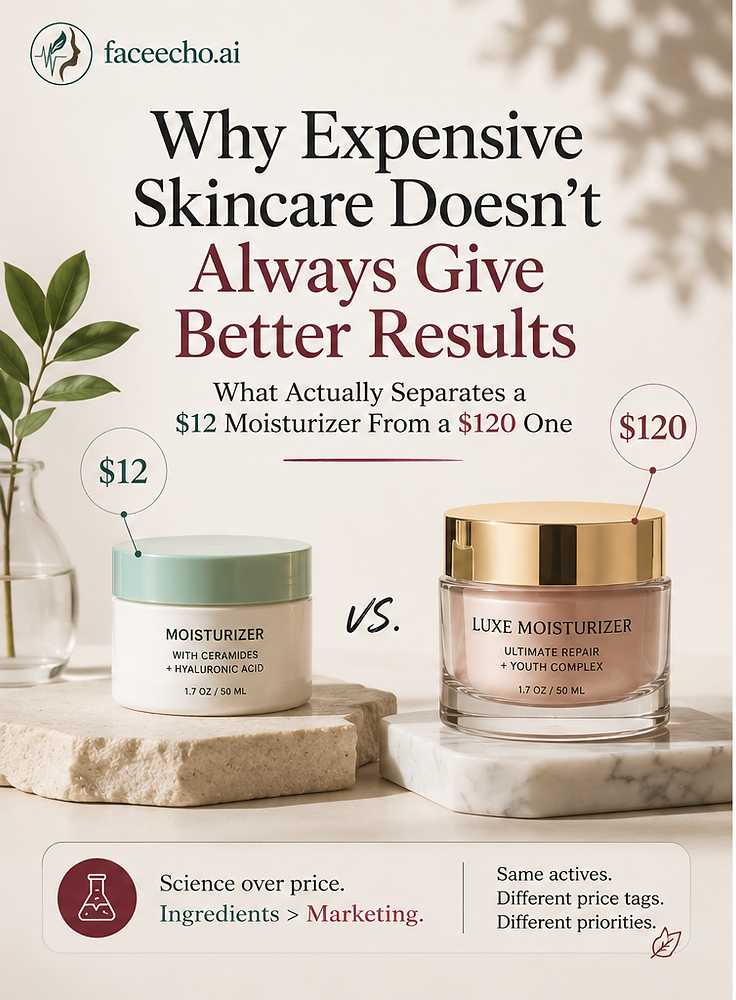
What Actually Separates a $12 Moisturizer From a $120 One
Quick Answer: Price and effectiveness are not reliably linked in skincare. Research on sunscreen, one of the most heavily studied categories, has found that products with identical active ingredients and identical SPF protection can vary in price by more than 3,000 percent with no meaningful difference in performance.[1] Because cosmetics in the United States are not required to prove efficacy before going to market, price often reflects packaging, marketing, and brand positioning as much as it reflects formulation.[2] That doesn’t mean expensive products are never worth it, certain actives genuinely cost more to stabilize and deliver, but it does mean price alone is a poor guide to what will actually work for your skin.
It’s an easy assumption to make: if a moisturizer costs ten times more than the one next to it on the shelf, it must do something the cheaper one can’t. Sometimes that’s true. Often, it isn’t. The skincare industry spends enormous amounts on packaging design, retail placement, and brand storytelling, and none of that spending necessarily translates into a formula that performs better on skin. Understanding where price actually comes from, and where it doesn’t, makes it much easier to spend money where it counts and skip the premium where it doesn’t.
What the FDA Actually Requires From Skincare Products
A crucial piece of context gets left out of most skincare marketing: cosmetic products in the United States are not required to demonstrate that they work before they’re sold. The FDA’s own guidance states plainly that cosmetic products and ingredients do not need premarket approval, with the exception of color additives, and the agency’s authority is largely limited to post-market enforcement against products that are unsafe or mislabeled.[2] This is fundamentally different from how drugs are regulated, and it means a product’s price tag says nothing about whether its efficacy claims were independently verified.
This regulatory gap is exactly why ingredient literacy matters more than brand reputation. One place where consumers do get useful, legally mandated information is the ingredient list itself: FDA labeling regulations require cosmetic ingredients to be listed in descending order of predominance, meaning whatever appears first is present in the highest concentration.[1] A vitamin C serum that lists ascorbic acid near the bottom of a long ingredient list is very likely underdosed relative to one that lists it near the top, regardless of what either product costs.
The Sunscreen Study That Changed How Dermatologists Talk About Price
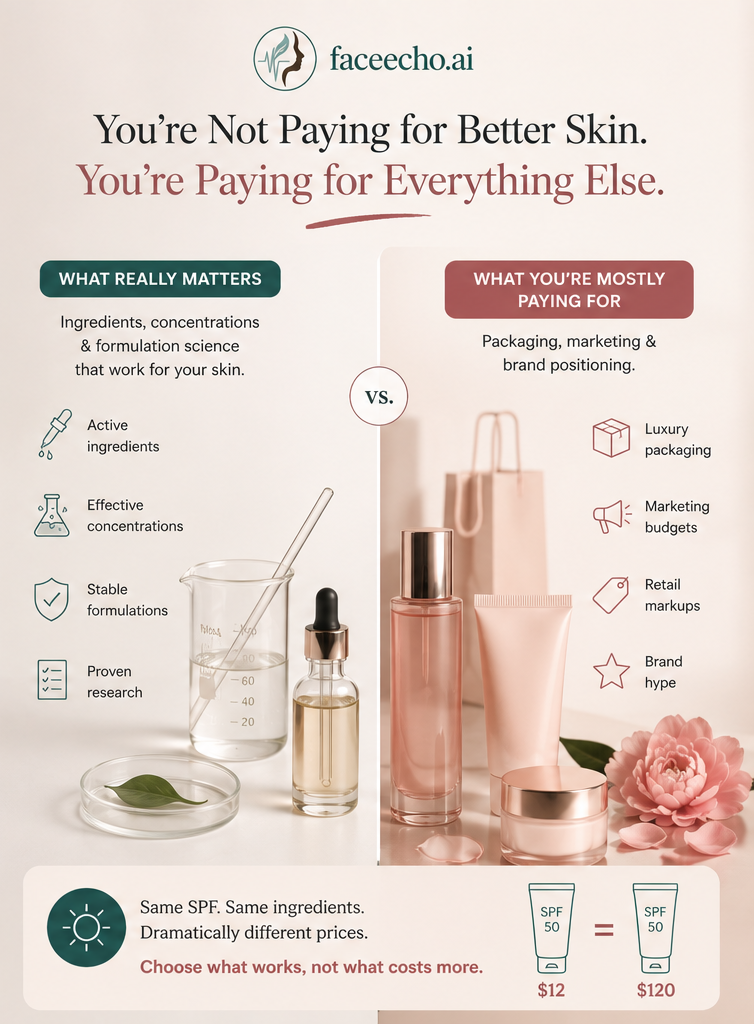
If there’s one product category where the price-versus-performance question has been studied directly, it’s sunscreen. A JAMA Dermatology analysis of top-selling sunscreens found that price varied by more than 3,000 percent across products, while roughly 40 percent of highly rated, expensive sunscreens actually failed to meet basic American Academy of Dermatology criteria for broad-spectrum and water-resistant protection.[3] In other words, a higher price didn’t just fail to guarantee better protection, it didn’t even guarantee the product met baseline dermatological standards.
A more recent economic evaluation reinforces the same point. Researchers comparing sunscreens with the same SPF 50 rating and similar active ingredients found the cost per application varied more than 17-fold, and the study’s lead dermatologist noted that less expensive sunscreen, when it shares the same active ingredients and SPF, is just as photoprotective as pricier alternatives.[4] The researchers also flagged a genuine downstream risk: when sunscreen costs climb, people tend to apply less of it than recommended, which means an expensive product used sparingly can end up protecting skin worse than an affordable one used generously and correctly.
Drugstore vs. Luxury: What’s Actually Different
The meaningful differences between drugstore and luxury skincare are real, but they’re narrower than most marketing suggests. Luxury brands do sometimes invest in more sophisticated delivery systems, encapsulated retinoids that release more slowly and cause less irritation, for instance, or specially stabilized forms of vitamin C that resist oxidation longer than the raw compound. These formulation techniques have genuine cost, and in cases where they measurably improve stability or reduce irritation, the added price can reflect added value.
But a large share of what separates a $15 moisturizer from a $150 one has nothing to do with what happens on skin. Packaging materials, glass versus plastic, retail markup, brand marketing budgets, and celebrity partnerships all factor into final price without affecting formulation quality. Many drugstore and prestige products share the same core actives at comparable concentrations, sourced from the same handful of major ingredient suppliers that serve the entire cosmetics industry, which is part of why dermatologists frequently recommend affordable products with confidence rather than treating them as compromises.
Why Active Ingredient Concentration Matters More Than Brand
The actual driver of whether a skincare product works is less about which brand made it and more about whether it contains a clinically meaningful concentration of an ingredient with real evidence behind it. Retinoids, vitamin C, niacinamide, and sunscreen filters all have research-backed effective concentration ranges, below a certain threshold, a product may simply not do much regardless of how elegant its packaging is. This is precisely why the FDA’s ingredient-ordering requirement is more useful to consumers than brand prestige: it’s a legally mandated, verifiable signal about formulation, not a marketing claim.
This is also where evidence-based skincare becomes a genuinely useful framework, prioritizing ingredients and concentrations with research support over price, packaging, or trend-driven claims. A budget retinol serum with a well-formulated, adequately dosed active ingredient will generally outperform an expensive product built around an unproven “miracle” ingredient with no meaningful research behind it, no matter how compelling the marketing copy sounds.
When Paying More Is Actually Worth It
None of this means price is always irrelevant. There are specific, legitimate reasons a higher-priced product might be worth the money. Certain actives, like stabilized L-ascorbic acid, genuinely require more sophisticated formulation science to remain effective over a product’s shelf life, since raw vitamin C degrades quickly when exposed to light and air. Encapsulation technology that measurably reduces irritation from potent actives like retinoids can also represent real, defensible cost, particularly for people with sensitive skin who’ve struggled to tolerate standard formulations.
Texture, scent, and overall sensory experience are legitimate reasons to spend more as well, even if they don’t affect clinical outcomes. If a luxury moisturizer’s texture makes someone genuinely more likely to use sunscreen or a retinoid consistently every day, that adherence benefit has real value, since consistency is one of the strongest predictors of skincare results regardless of what’s driving it. The mistake isn’t spending more; it’s assuming that spending more is a guarantee of better results without checking what’s actually in the product.
What This Means for Your Skincare Routine
Before assuming a higher price means a better product, check the ingredient list for the actives that matter for your specific concern and where they fall in the concentration order. A product’s price should be weighed against genuine formulation differences, stabilization technology, delivery systems, proven concentrations, rather than assumed automatically from brand name or packaging alone. It’s also worth remembering that consistency beats intensity: a correctly formulated, affordable product used every day will typically outperform an expensive one used inconsistently because it feels like a splurge to be saved for special occasions.
Budget is also not something to treat as separate from skin needs; it’s part of building a routine that’s actually sustainable long term. New beauty platforms, including FaceEcho, are built to factor budget in alongside skin concerns from the start, generating recommendations that span both affordable and luxury products so people aren’t forced to choose between what their skin needs and what they can realistically spend.
Frequently Asked Questions
1. Does the FDA verify that skincare products actually work before they’re sold?No. Cosmetic products and ingredients in the United States do not require FDA premarket approval to demonstrate efficacy, only safety and proper labeling.[2]
2. Is expensive sunscreen actually better protection than cheap sunscreen?Not necessarily. Research has found sunscreen prices varying by more than 3,000 percent with no consistent link to better protection, and some expensive, highly rated sunscreens failed to meet basic dermatological guidelines.[3]
3. How can I tell if a product actually contains enough of an active ingredient to work?Check where the ingredient falls on the label. FDA regulations require cosmetic ingredients to be listed in descending order of concentration, so an active listed near the bottom is likely present in a very small amount.[1]
4. Are drugstore and luxury moisturizers really that similar?Often, yes. Many share overlapping core ingredients at comparable concentrations, though luxury products sometimes include more advanced stabilization or delivery technology that can justify some of the price difference.
5. Why do people underuse expensive sunscreen?Research has found that as sunscreen prices increase, people tend to apply less than the recommended amount, which can reduce real-world protection regardless of the product’s SPF rating.[4]
6. What’s considered “evidence-based” skincare?It generally refers to prioritizing ingredients and concentrations supported by clinical research over unproven trends, exotic-sounding ingredients, or marketing claims without independent verification.
7. Is it ever worth paying more for skincare?Yes, in specific cases: certain actives require costly stabilization technology to remain effective, and some delivery systems genuinely reduce irritation, both of which can represent legitimate added value.
8. Can two products with the same active ingredient perform differently?Yes. Performance depends on concentration, formulation stability, and delivery method, not just whether an ingredient appears somewhere on the label.
9. Does a higher price mean a product went through more testing?Not necessarily. Since cosmetics aren’t required to prove efficacy before sale, a higher price doesn’t guarantee more rigorous testing or better substantiated claims.
10. Should budget be part of a personalized skincare recommendation?Yes. A sustainable routine has to fit what someone can realistically afford long term, which is why useful recommendations account for both skin needs and budget together.
References
[1] U.S. Food and Drug Administration. Cosmetic Ingredient Names and 21 CFR 701.3, Designation of Ingredients. Official regulation. fda.gov.
[2] U.S. Food and Drug Administration. FDA Authority Over Cosmetics: How Cosmetics Are Not FDA-Approved, but Are FDA-Regulated. Official guidance. fda.gov.
[3] Xu S, Kwa M, Agarwal A, Rademaker A, Kundu RV. Sunscreen Product Performance and Other Determinants of Consumer Preferences. JAMA Dermatology. 2016;152(8):920-927. PMID: 27385189.
[4] Mundada M, et al. Sunscreen Costs in Association With Sun Protective Behaviors. JAMA Dermatology. 2026. Reported via UCSF News.
[5] American Academy of Dermatology Association. Skin Care on a Budget. Official guidance. aad.org.