
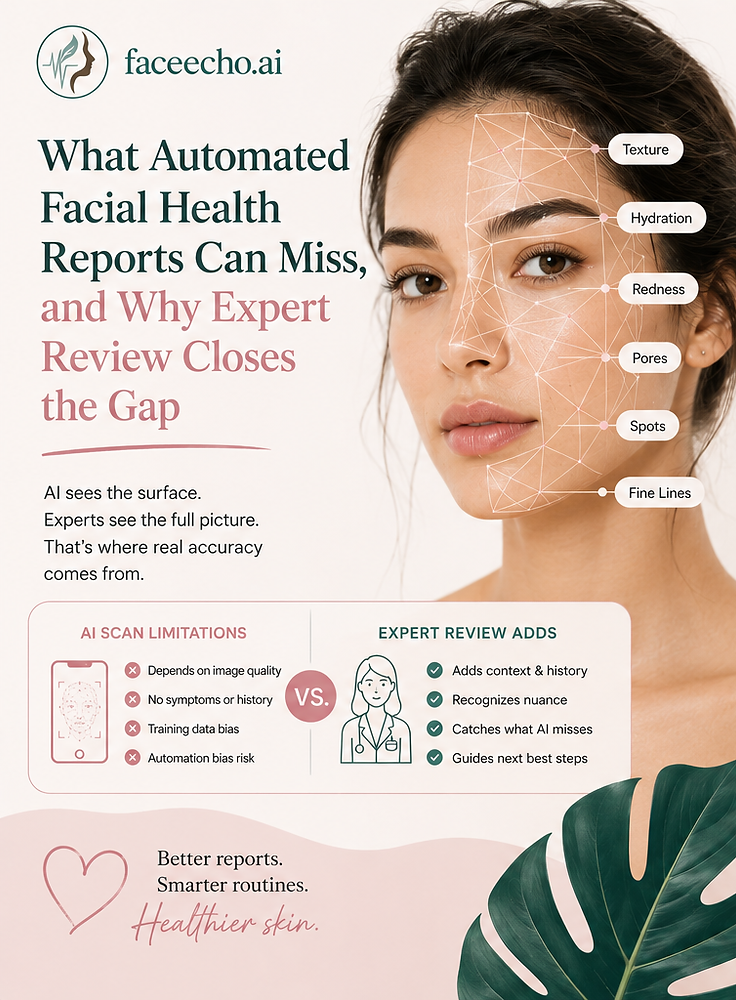
What Automated Facial Health Reports Can Miss, and Why Expert Review Closes the Gap
Quick Answer: An AI-generated facial health report can process image data quickly and consistently, but research on AI in dermatology and image analysis shows real, documented limitations: accuracy that depends heavily on image quality, training data that historically underrepresents certain skin tones, and a specific risk called automation bias, where human reviewers start trusting an AI’s output even when it’s wrong.[1][2][3] Expert review isn’t a formality layered on top of a scan for reassurance. It exists to catch the specific categories of error that image analysis alone reliably produces, and research on human-AI collaboration shows that review only works if it’s genuine rather than a quick rubber stamp.
A facial scan can generate a detailed-looking report in seconds: hydration levels, redness, texture scores, pore visibility, maybe a projected age or a list of flagged concerns. It’s easy to treat that report as a finished, objective answer, especially when it comes with clean percentages and color-coded charts. But a report generated entirely from image data has specific, well-documented blind spots, and understanding what those are is the difference between using a facial health report as a genuinely useful tool and treating it as more authoritative than it actually is.
What an AI Facial Health Report Can and Can’t Actually Tell You
Image-based analysis is genuinely good at certain things: measuring visible surface characteristics consistently, comparing an image against enormous reference datasets, and flagging patterns a person might not notice themselves. A comprehensive review of AI in dermatology imaging notes that dermoscopy, the magnified imaging technique dermatologists use, achieves around 80 percent diagnostic accuracy under typical clinical conditions even with expert human interpretation, and that AI can meaningfully complement that process rather than replace it outright.[1] That figure matters here: even a well-established, expert-reviewed imaging method isn’t 100 percent accurate, which sets realistic expectations for what a phone-camera-based facial scan can reasonably claim to measure.
What a photo genuinely cannot capture is just as important. It can’t tell you whether skin feels tight after cleansing, whether a spot is painful or itchy, how long a concern has been present, or whether it changes with diet, stress, or hormonal shifts. Clinical guidance on AI-based skin apps points out that accuracy is also highly sensitive to image quality, lighting, focus, angle, shadow, and camera model can all shift results meaningfully, and that historically, many AI models have been trained on datasets that underrepresent darker skin tones and less common presentations, which measurably reduces accuracy for those groups.[3] A report generated purely from a single image inherits all of these constraints whether or not the interface communicates them clearly.
The Automation Bias Problem: Why Review Has to Be Genuine
Here’s the part that rarely gets discussed: adding a human reviewer to an AI-generated report doesn’t automatically fix its blind spots. Research on human-AI collaboration in dermatology found something worth taking seriously: when the AI model made mistakes, human participants reviewing its output were significantly more likely to make the same mistake themselves, because they tended to follow the model’s suggestion rather than independently verifying it.[2] This pattern, often called automation bias, means a reviewer who simply glances at an AI report and confirms it isn’t actually providing the safeguard the process is supposed to offer.
This is precisely why meaningful expert review has to involve genuine independent judgment, not a quick confirmation click. A reviewer who understands where AI models commonly go wrong, and who’s trained to look past a confident-sounding report rather than defer to it, is doing something categorically different from a reviewer who’s just checking a box. The value of human oversight depends entirely on whether that oversight is structured to counteract this bias rather than accidentally reinforce it.
What Expert Review Actually Catches
Given these known gaps, expert review tends to add value in a few specific, identifiable ways. First, experts can weigh context a photo doesn’t contain: reported symptoms, history, product use, and how a concern has evolved over time, all of which shape whether a flagged issue is minor or worth further attention. Second, experts are positioned to recognize when a scan’s confidence doesn’t match the actual difficulty of what it’s assessing, since even specialist dermatologists show notably lower agreement with each other on genuinely ambiguous cases, meaning a report presenting a borderline call as a clean, confident score can be misleading on its own.
Third, and perhaps most practically, experts can distinguish between a cosmetic concern suited to a skincare or makeup recommendation and something that warrants a referral to a medical professional, a distinction an image-analysis model isn’t designed to make reliably. Research on dermatologist and patient attitudes toward AI found that most professionals see the greatest value in AI for narrowly defined, specific tasks rather than broad automated diagnostic conclusions, and that patients themselves are generally open to AI tools as long as the process preserves a real connection to a human professional rather than replacing it entirely.[4] That combination, narrow AI tasks plus a retained human relationship, is a fairly direct description of what expert-reviewed reporting is supposed to look like in practice.
Why This Distinction Matters More as These Reports Become Common
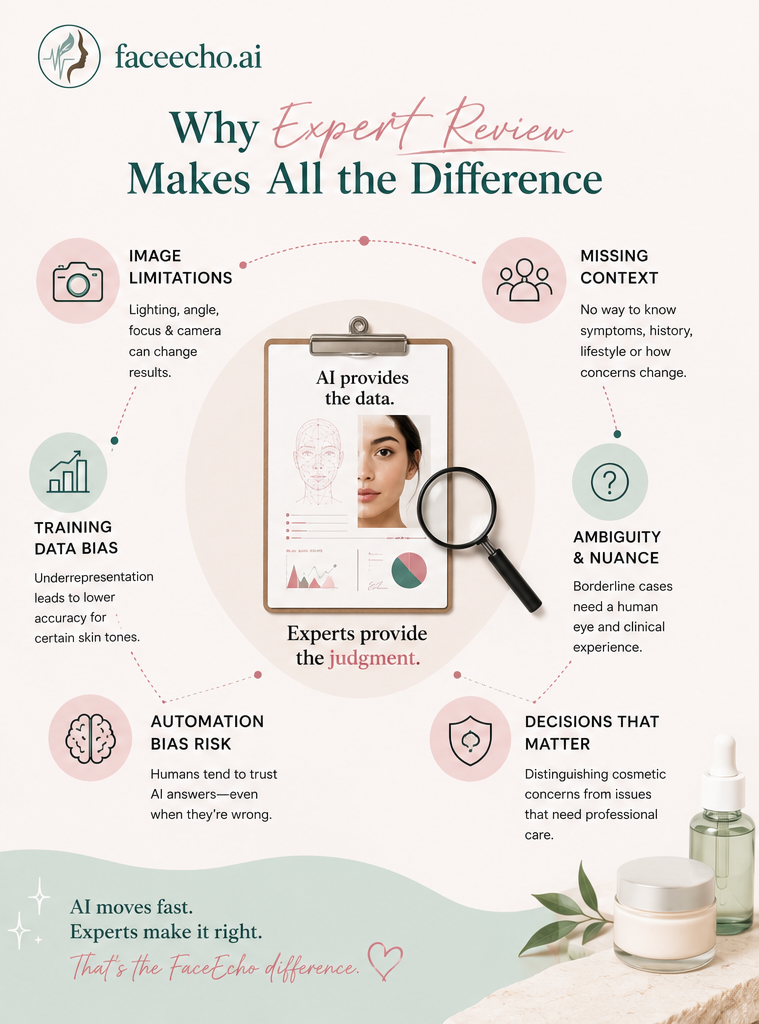
As AI-generated facial health reports become a standard feature across beauty apps and platforms, the gap between “AI-generated” and “AI-generated and expert-reviewed” is becoming one of the more meaningful quality signals available to consumers. A report that’s purely algorithmic inherits every limitation described above with no check in place. A report that’s been genuinely reviewed by someone trained to catch bias, ambiguity, and missing context is a materially different product, even if the two look identical on a screen.
This is the structure behind how FaceEcho approaches its facial health reports: an AI scan generates the initial analysis, and beauty experts are available to review and interpret those results rather than leaving the automated output as the final word. That review step exists specifically to catch the categories of gap covered here, image-quality dependence, potential bias in how the underlying model was trained, and the difference between a cosmetic pattern and something that deserves closer attention, rather than functioning as a marketing add-on to an otherwise fully automated process.
What This Means for Your Beauty Routine
Treat an AI-generated facial health report as a genuinely useful starting point, not a finished verdict. If a report flags something with high confidence, it’s still worth checking that confidence against how the image was captured, lighting, angle, camera quality, since those variables measurably affect accuracy. And if a report or a routine recommendation is available with expert review, that review is worth more than a fast turnaround alone; the value of the whole system depends on whether that human step is a genuine second look rather than a quick confirmation of whatever the AI already concluded.
Frequently Asked Questions
1. How accurate are AI-generated facial health reports?Accuracy varies significantly and depends heavily on image quality, lighting, and the diversity of the data the underlying model was trained on; even expert-level imaging methods like dermoscopy achieve roughly 80 percent accuracy, which sets a realistic ceiling for photo-based consumer tools.[1]
2. Can a human reviewer just approve an AI report without adding real value?Yes, and this is a documented risk. Research shows that reviewers exposed to an AI’s mistakes tend to make the same errors themselves by deferring to the model’s suggestion rather than independently verifying it.[2]
3. Why does image quality affect an AI skin scan so much?Lighting, angle, focus, and camera model all shift how accurately an image-based model can assess skin, which is why the same face can generate different results depending on how the photo was taken.[3]
4. Do AI skin analysis tools work equally well across all skin tones?Not always. Many models have historically been trained on datasets underrepresenting darker skin tones, which has been shown to reduce accuracy for those groups.[3]
5. What can’t an AI facial scan detect that a human expert could?A scan can’t assess symptoms like itching or pain, how long a concern has existed, or how it changes with diet, stress, or hormones, all of which require reported context rather than an image alone.
6. Is AI expected to replace dermatologists or beauty experts?Most professional attitudes lean toward AI serving narrowly defined, specific tasks rather than fully automated diagnostic conclusions, with human expertise remaining central to the process.[4]
7. Why would a facial health report need expert review if AI is already accurate?Because even highly accurate systems have known blind spots around image quality, training data bias, and ambiguous cases, and expert review exists specifically to catch what falls into those gaps.
8. Do patients actually want AI involved in their skincare analysis?Research suggests patients are generally open to AI tools for skin monitoring, provided the process maintains a genuine connection to a human professional rather than removing it.[4]
9. What’s the difference between a “score” from a scan and a full report?A score is typically a narrow, single-metric output, while a fuller report can combine multiple measurements with context and interpretation, which is where expert input adds the most value.
10. How does FaceEcho combine AI scanning with expert review?An AI scan generates the initial facial health report, and beauty experts are available to review and interpret those results, adding context and catching gaps that image analysis alone would miss.
References
[1] AI in Dermatology: A Comprehensive Review Into Skin Cancer Detection. NCBI PMC. pmc.ncbi.nlm.nih.gov/articles/PMC11784784.
[2] DermINO: Hybrid Pretraining for a Versatile Dermatology Foundation Model. arXiv preprint, on human-AI collaboration and automation bias in diagnostic review. arxiv.org/pdf/2508.12190.
[3] Forefront Dermatology. AI Skin Apps vs. Dermatologists: Why Professional Diagnosis Still Matters. Official clinical guidance. forefrontdermatology.com.
[4] Artificial Intelligence in Dermatology Image Analysis: Current Developments and Future Trends. NCBI PMC. pmc.ncbi.nlm.nih.gov/articles/PMC9693628.